

Introduction: The Shift from Synthetic Pigments to Clean-Label Aesthetics
If you have been monitoring global market trends for dietary supplements over the past two years, one requirement has become clear: brand owners no longer want synthetic colorants.
With the European Union’s ban on Titanium Dioxide (TiO2 / E171) and increasing consumer scrutiny around artificial food dyes (such as FD&C Yellow or Blue), supplement brands are caught in a challenge. R&D teams need a capsule shell that provides dark, elegant light-blocking aesthetics without adding synthetic chemicals to the ingredient label.
This is where Chlorophyll-pigmented HPMC (Hydroxypropyl Methylcellulose) capsule shells come into play. Derived from natural plant sources, sodium copper chlorophyllin provides a rich, forest-green hue that naturally aligns with plant-based, organic, and clean-label supplement formulations.
Below, we break down the technical performance, moisture control physics, color stability considerations, and machine filling efficiency of Chlorophyll HPMC empty capsule shells.
1. Plant-Based Matrix: HPMC Compatibility with Sensitive Actives
For botanicals, greens powders, spirulina, and moisture-sensitive extracts, the capsule matrix material is just as critical as its color.
Standard gelatin capsules inherently contain 13.0% to 16.0% moisture. When filled with highly hygroscopic powders (such as barley grass, green tea extracts, or probiotics), gelatin shells tend to lose moisture to the dry fill, leading to brittleness, shell cracking, or cross-linking over time.
In contrast, our Chlorophyll HPMC capsules maintain a low, tightly controlled moisture content of 4.0% to 7.0%.
- Low Water Activity (Aw): Minimizes moisture migration from the shell into hygroscopic green superfood formulations.
- Non-Animal & Non-GMO: Completely free of bovine/porcine DNA, making them 100% suitable for Vegan, Vegetarian, Halal, and Kosher certified products.
- No Cross-Linking: Unlike gelatin, HPMC does not undergo cross-linking when exposed to aldehydes or specific polyphenol-heavy botanical extracts, ensuring consistent dissolution rates throughout shelf life.
2. Visual Differentiation & Natural Color Stability
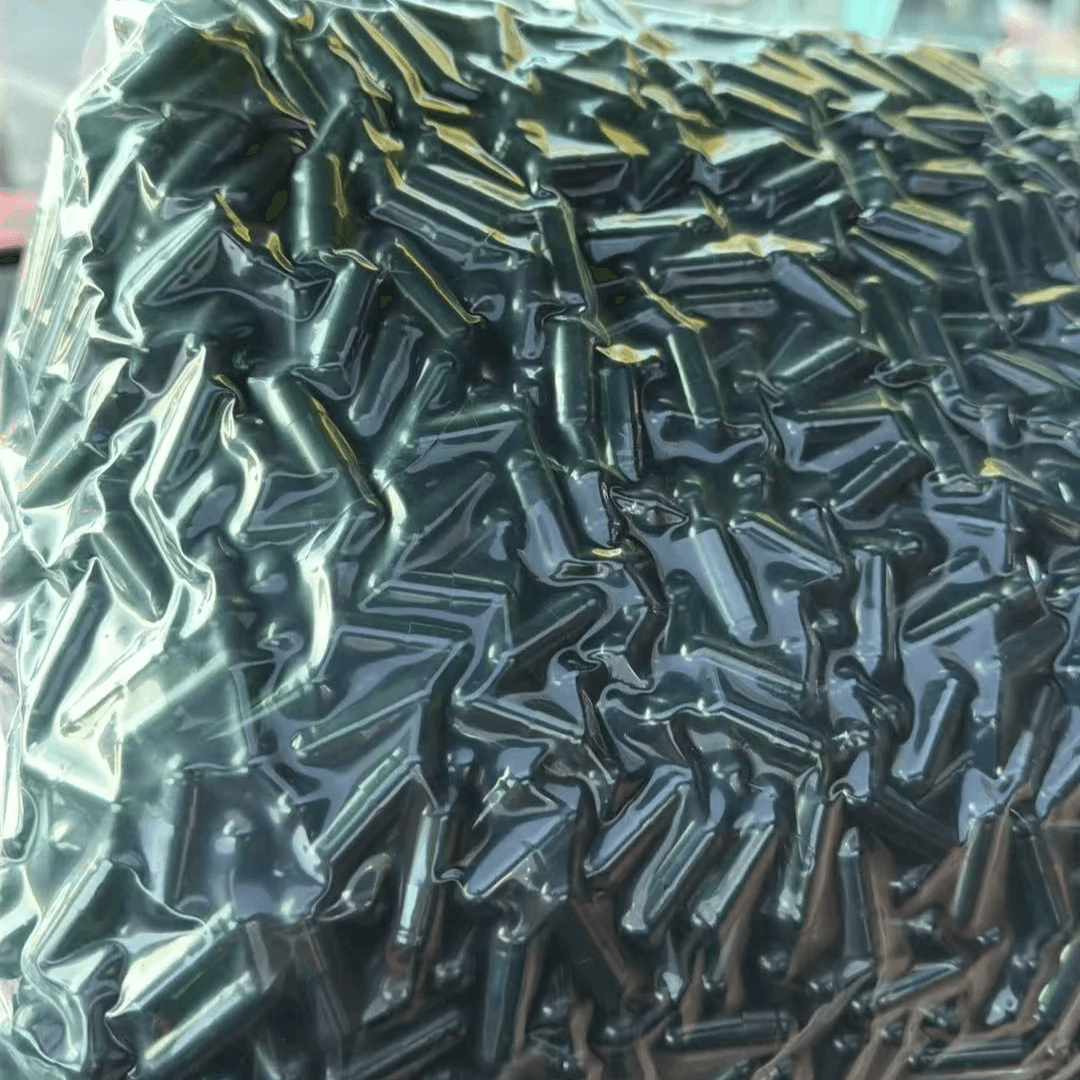
Formulation Insight: Natural pigments often carry a reputation for being prone to photo-degradation or batch-to-batch shade inconsistency.
To overcome this, our manufacturing process utilizes refined sodium copper chlorophyllin integrated directly into the HPMC polymer matrix during dip-molding. This engineered cross-dispersion ensures:
- High Light Opacity: The deep emerald shade naturally blocks visible light wavelengths, protecting light-sensitive compounds (such as chlorophyllin derivatives, carotenoids, and delicate phytonutrients) inside the capsule.
- Thermal & Storage Stability: Unlike raw chlorophyll extracts which degrade quickly under ambient conditions, matrix-bound chlorophyllin retains shade uniformity during long-term storage within standard ambient warehouse parameters (15℃ - 25℃, 35% - 65% RH).
3. Technical Comparison: Chlorophyll HPMC vs. Traditional Capsules
To help formulation scientists and procurement managers evaluate the technical specs, here is a direct performance breakdown:
| Technical Parameter | Chlorophyll Natural HPMC Capsules | Synthetic Green Gelatin Capsules | Titanium Dioxide (TiO2) Pigmented |
|---|---|---|---|
| Shell Material | Pure HPMC (Plant Cellulose) | Bovine / Porcine Gelatin | Gelatin or Early-Gen HPMC |
| Coloring Agent | Natural Chlorophyll Derivative | Artificial Dyes (FD&C Green) | TiO2 + Synthetic Dyes |
| Moisture Content | 4.0% – 7.0% | 13.0% – 16.0% | 4.0% – 16.0% |
| EU / Global Compliance | 100% Clean-Label Compliant | Restricted in natural lines | Banned in EU (E171) |
| Cross-Linking Risk | Zero Risk | High (with polyphenols) | Moderate to High |
4. High-Speed Machine Runnability & Tooling Guidelines
A beautiful capsule is useless if it causes downtime on the production line. A common concern with natural pigment capsules is whether the formulation alters shell elasticity or wall consistency.
Our Chlorophyll HPMC capsules are manufactured under strict dimensional tolerances (ISO standards) to ensure seamless compatibility with high-speed automatic encapsulation machines (such as Bosch, Capsugel/Lonza style tooling, or Chinese automatic fillers).
Machine Setup Recommendations for Contract Manufacturers:
- Pre-Lock & Snap Lock Pressure: Maintain standard locking lengths (e.g., 18.5mm ± 0.4mm for Size 0#) to avoid dome deformation.
- Environmental Control: Operate filling rooms at 20℃ - 24℃ and 40% - 55% RH to preserve optimal shell flexibility during dosing disk insertion.
- Vacuum Transfer: Ensure suction cups on automatic separation stations are clean and free of fine green powder dust to ensure a 99.9% capsule opening rate.
5. Ideal Product Applications
Chlorophyll HPMC capsules offer immediate visual communication for brands launching products in the following categories:
- Greens & Detox Formulas: Wheatgrass, chlorella, spirulina, and broccoli sprout extracts.
- Herbal & Botanical Nootropics: Ashwagandha, Bacopa, and green tea extracts (EGCG).
- Clean-Label Anti-Aging & Antioxidants: Phytoplankton, chlorophyll drops alternative in solid dose form, and plant-derived multivitamin blends.
Frequently Asked Questions (FAQ)
Ready to Upgrade Your Product Line to Clean-Label Chlorophyll Capsules?
At EEK Pharma, we specialize in high-performance empty capsule shell manufacturing engineered for strict regulatory standards and high-speed filling lines.
Whether you are reformulating to remove synthetic colors or developing a new premium plant-based supplement, our team provides full technical support, Certificate of Analysis (COA) documentation, and fast sample dispatched globally.
Contact our technical sales team today to request a free sample pack or quote.
📩 Email us at [kevin@eekpharma.com]
📞 Direct Phone: [+86 13561623550]